 CMDApp
Design the mix.Test the pour.Certify the concrete.
One record from the weighbridge to the signed certificate — and the analysis engine that tells you whether the pour will crack before you cast it.
One quality process, living in eleven places at once
Poor concrete quality can cost 5–21% of project value, and most of it is preventable. The process that prevents it is spread across a dozen systems, five bound logs and three spreadsheets — each held by a different person, none of them able to see what the others recorded. By the time the defect surfaces, the batch record that would have explained it no longer exists in any usable form.
Rework as % of project value — CII, Report 153, Get It Right Initiative (UK)
Where the 5–21% goes
% of project value, reworkBefore — eleven places, eleven people
- A mix-design spreadsheet, one per engineer
- Trial-mix results written on cards
- Batch slips filed in a drawer
- Weighbridge printouts, rolled up
- A lab register, hard-bound
- A compliance checklist, printed
- An SPC workbook, rebuilt monthly
- A curing-tank log on the wall
- Calibration certificates and a due-date diary
- An NCR log chased over email
- A month-end Excel pivot nobody reconciles
With CMDApp — one record
- One material library, reused on every mix
- Trial campaigns scored side by side on evidence
- Batch tickets read by OCR, deviation flagged
- Weighbridge telemetry posted straight in
- Clause-tagged test records, clause on the form
- Compliance applied on entry, not on audit
- Live SPC per grade, per project location
- Curing register with chain of custody
- Calibration register — overdue blocks the test
- NCR → CAPA linked through to closure
- 22 live dashboards, the audit trail one export away
From mix design to certified report — every test, every compliance check, every SPC chart, every NCR.
Six stages — the same six you already run, just not on paper
Materials
Design
Trials
Production
Quality
Insights
Nine mix-design methods, one hub, compared side by side
IS 10262:2019, ACI 211, BRMCA/DoE and EFNARC (SCC) — plus HSC, UHPC, CLSM and lightweight — with a compliance matrix so you can see which method the job needs before you start.
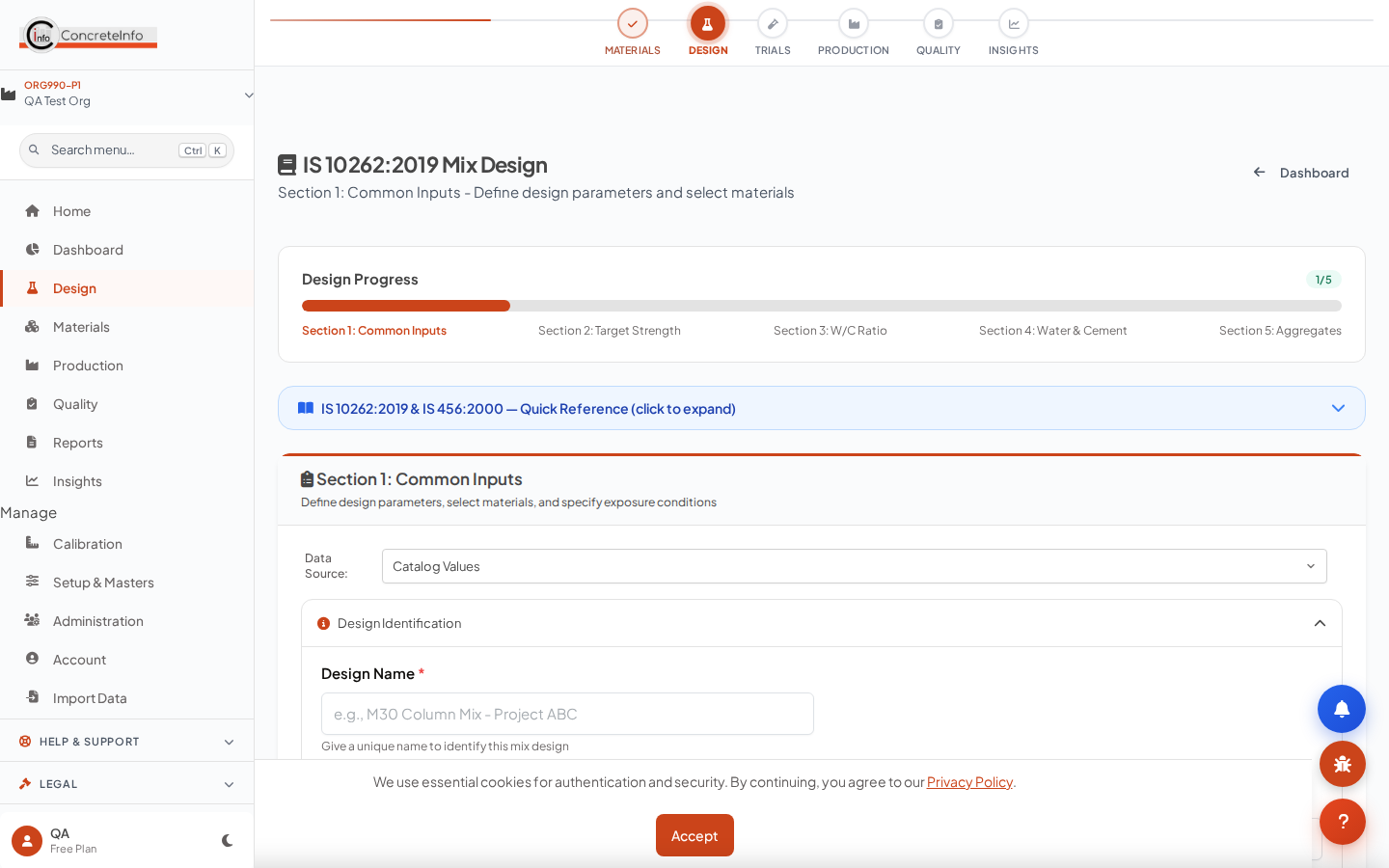
- Five-section guided wizard — code quick-reference on the same screen
- Auto-filled from the plant spec — grade, exposure, slump and target w/c, never retyped
- Particle-packing engine — voidage-minimising, tightens the combined curve
- SCM optimiser — fly ash, GGBS, silica fume against the target grade
- Moisture-adjusted quantities — and embodied carbon in kg CO₂e/m³ on every design
M25 · quantities per m³
kgParticle packing — combined gradation
% passing60+ tests, every one tagged to its clause
Not just the cube test. Twenty-seven concrete tests, eleven each on cement and aggregate, six SCMs, four on water, plus admixtures, fibres and steel — each carrying its own IS or ASTM reference on the entry form, so the standard is never a memory test.
Fineness (Blaine & sieve), consistency (Vicat), setting time, soundness, compressive, tensile and transverse mortar strength, heat of hydration, density, chemical analysis
IS 4031 · IS 4032Fly ash, GGBS and silica fume as separate library items. Fly ash, GGBS, silica fume, metakaolin, ultra-fine fly ash and ultra-fine GGBS. Fineness, specific gravity, loss on ignition, pozzolanic reactivity, oxide composition
IS 3812 · IS 16714 · IS 15388Sieve analysis and grading zone, full IS 383 assessment, specific gravity, water absorption, crushing and impact value, LA abrasion, flakiness & elongation, bulk density, moisture, organic impurities
IS 2386 P1–P4 · IS 383Type, relative density and dosage range, chloride content, solids content, setting-time compatibility, manufacturer datasheet linked per batch
IS 9103 · IS 10230Source and pH logged per batch, organic and inorganic solids, sulphate and chloride limits, against the potable-water benchmark
IS 456 Cl. 5.4Steel, synthetic or glass — logged by type. Aspect ratio and dosage, tensile strength against the manufacturer datasheet
manufacturer datasheetBar tests recorded against the pour they went into, rather than in a separate register
IS 1786 · IS 1608Slump cone, Vee-Bee consistometer, compacting factor and yield test — each with its own tolerance band, against IS 1199
IS 1199Fresh density by IS 1199 Pt 5, unit weight and computed yield — the check that catches a mis-batched load before it leaves the bay
IS 1199 Pt 5Pressure-method air content with the aggregate correction applied. Void structure recorded while the concrete is still workable
IS 1199 Pt 6Recorded at discharge and at placement. Feeds the ACI 305 / ACI 306 hot- and cold-weather adjustments and the evaporation model
ACI 305 · ACI 306Observed and recorded at discharge — the check that a load will not segregate in the pump line or the formwork
observation, logged per pourSlump flow, T500, V-funnel, L-box and J-ring, scored against the EFNARC acceptance classes rather than a single slump number
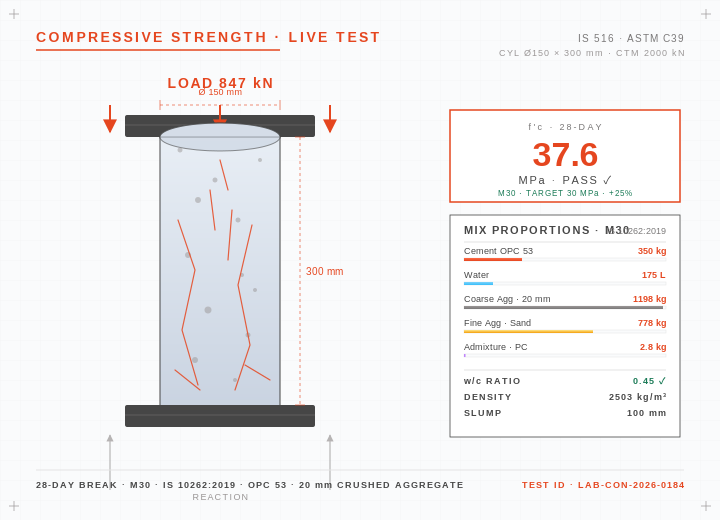
EFNARC 2005Cubes and cylinders, IS 516. Age-gated acceptance, ±15% variation alert, failure-type classification and 0.5 MPa rounding
IS 516 · IS 456 Cl. 16.1Modulus of rupture on a beam, three-point loading, with the span-to-depth ratio carried on the record
IS 516Indirect tension on a cylinder, IS 516 Pt 1 Sec 1 — whether the concrete holds together in shear, not only in compression
IS 516 Pt 1 Sec 1Stress-strain response captured, not just the peak — the number that goes into the structural calculation
IS 456 · IS 516Nurse-Saul and equivalent-age methods on logged temperature, feeding the IS 456 Table 11 stripping recommendation
IS 456 Table 11In-situ cores extracted, logged against the element they came from, and reconciled with the cubes from the same pour
IS 516 Pt 5Surface hardness, IS 516 Pt 5, correlated against the cores taken from the same element rather than used alone
IS 516 Pt 5Ultrasonic pulse velocity with transducers on the surface, plus half-cell potential for corrosion risk — mapped element by element
IS 516 Pt 5 · ASTM C876Water absorption, sorptivity and water permeability to depth, IS 3085 / DIN 1048 — the tests that predict ingress, and the repair bill
IS 3085 · DIN 1048Rapid chloride permeability per ASTM C1202 — whether corrosion is a question of when, not whether
ASTM C1202Phenolphthalein sprayed on a split face — how far the carbonation front has moved, and how long until the rebar loses its protection
phenolphthalein depthDurability factor after repeated freezing and thawing, ASTM C666 — whether an iced, salted slab survives its first winter
ASTM C666Sulfate resistance, acid and alkali exposure, and alkali–silica reaction (ASR) — the tests that decide whether the mix survives its environment
IS 456 · IS 10262Potential reactivity of the aggregate against the cement alkalis, and the SCM mitigation needed to suppress the reaction in the finished concrete
IS 383 · IS 456Rate at which concrete takes up water — the front-line indicator for surface ingress, ahead of the water-permeability test
IS 3085 · EN 1920Surface chloride content and ingress depth measured on the structure itself — where the steel actually is
IS 1199 · ASTM C876Resistance of the mix to sulfate attack over an extended exposure period — the deciding test for marine, industrial and sewage structures
IS 10262 · IS 456Prism length change over time, on the same mix that went into the structure — the input the crack-risk model actually uses
ACI 209 · IS 45628-day results vs fck
M30 · per grade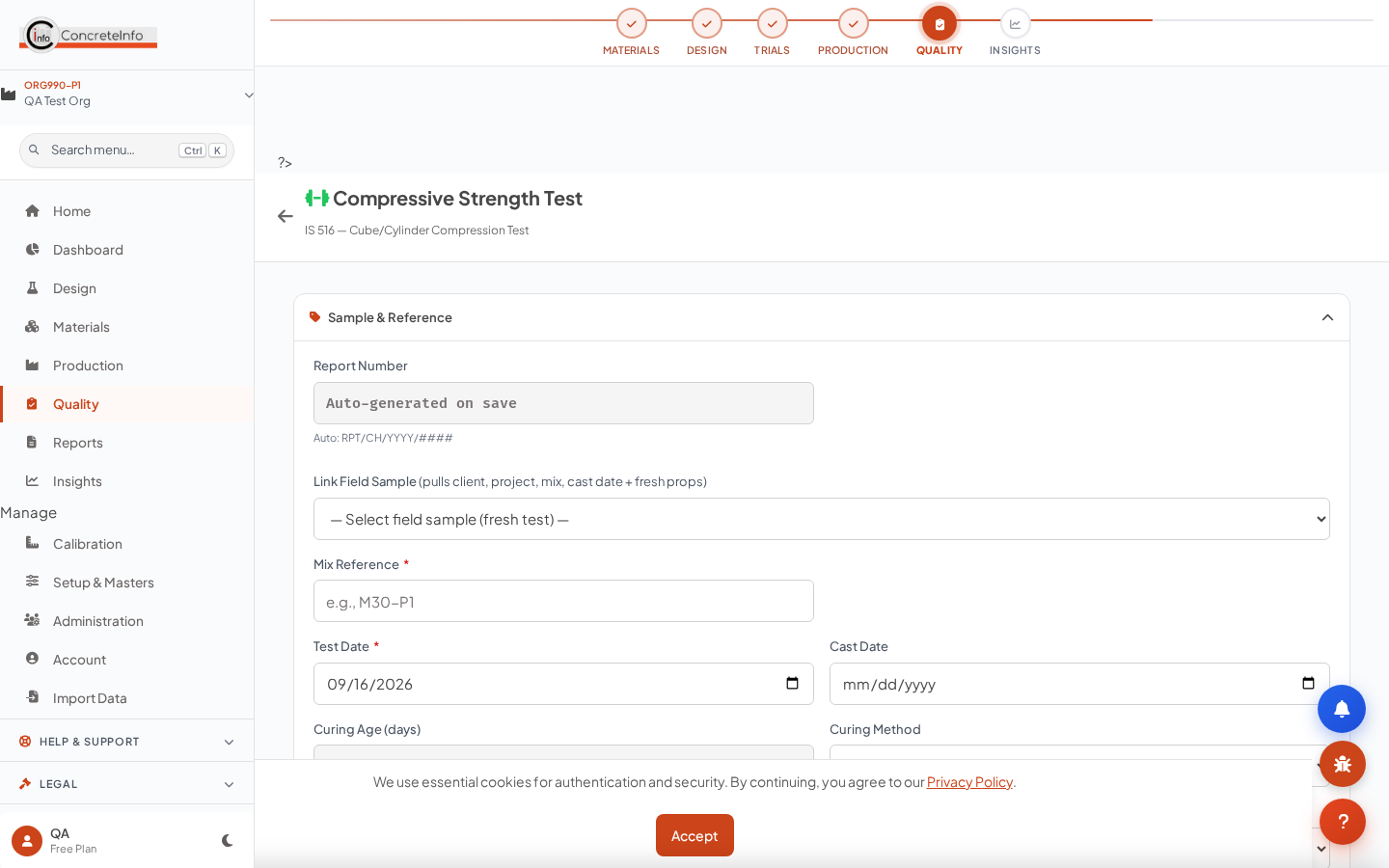
The bookkeeping, not the testing
Numbering, automatic
every timeFresh ↔ hardened, linked
no re-entryCalibration guard
blocks, not warnsYour plant systems write into the same record
An authenticated REST layer with per-module permissions, webhooks and rate limiting. A weighing-bridge terminal, a lab instrument, an ERP and a phone camera all post into the records your team opens in the morning — no re-keying in between.
Machine & plant ingest
instrument → record- Weighbridge telemetry — batch quantities post straight into the design-versus-actual comparison
- Compressive & sieve results — posted as the printout finishes
- Photographed batch tickets — OCR reads the slip into fields
Business systems
ERP · accounting- Mix designs and results — addressable without a browser
- Reports and exports — PDF, Excel, Word and CSV generated server-side
- Billing and usage — consumption against plan limits
Outbound & alerts
push · webhook- Webhooks — fire on result, NCR, approval and CAPA deadline
- WhatsApp channel — a supervisor can log from a phone
- Calendar feed — calibration and test due dates, subscribeable
What that stops
the actual saving- No re-keying — a batch becomes a pour, a cube and a certificate without four handovers
- No transcription error — the number the instrument printed is the number that gets reported
- No month-end reconciliation — ERP and plant agree because there is only one set of records
Access model
least privilege by default- Token-authenticated — scoped keys, revocable, per organisation
- Permission per module — an integrator never holds administrative scope
- Rate limited and logged — every call lands in the same audit trail as the laboratory data
Route documentation, sample payloads and key management are issued to integrators on request — not published here. Ask us for the developer pack.
Batching to pour, tracked as it happens
The batch slip is photographed, the deviation is flagged, and the pour register keeps score — live IS 456 pass/fail counts against every pour logged that day.
Batch ticket — design vs actual
OCR read, deviation flagged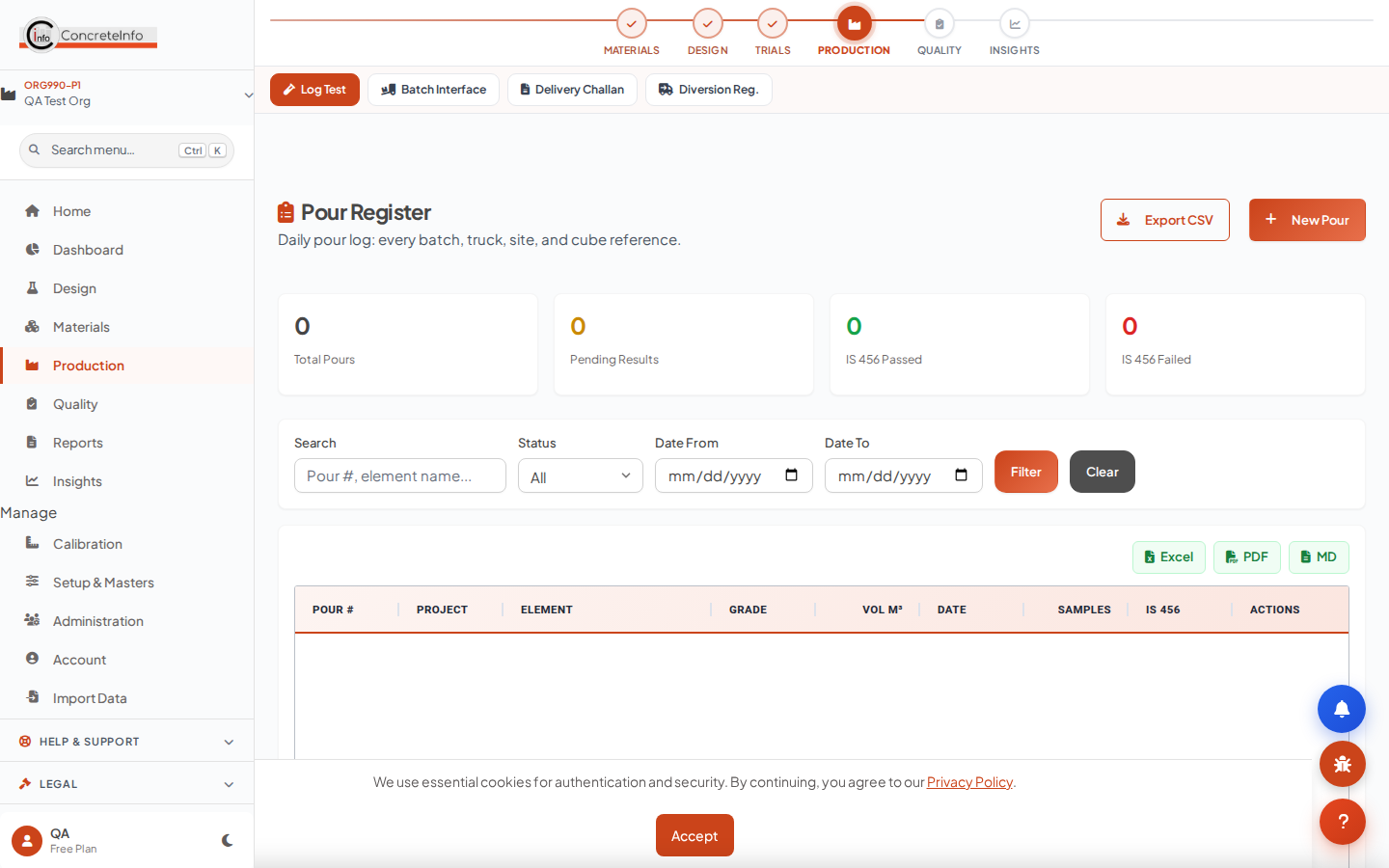
Pour register
Daily logging, filterable by status and date, exportable in one click — with retention and unload-delay thresholds you set per product.
retention & unload-delay alerts, configurable per productDelivery & production
Challans, a live production dashboard, and the production hub shared across plants.
GPS capture + signature pad on deliveryCuring & specimens
Tank assignment, specimen tracking and the append-only chain-of-custody ledger.
QR sample tags scan to the recordRepairs management
Method, material and quality verification tracked to closure.
feeds Pareto analytics and CAPAEquipment & competency
Equipment registry, calibration expiry alerts, technician competency matrix.
an overdue CTM blocks the test it invalidatesDocument control
Version control with approval workflows.
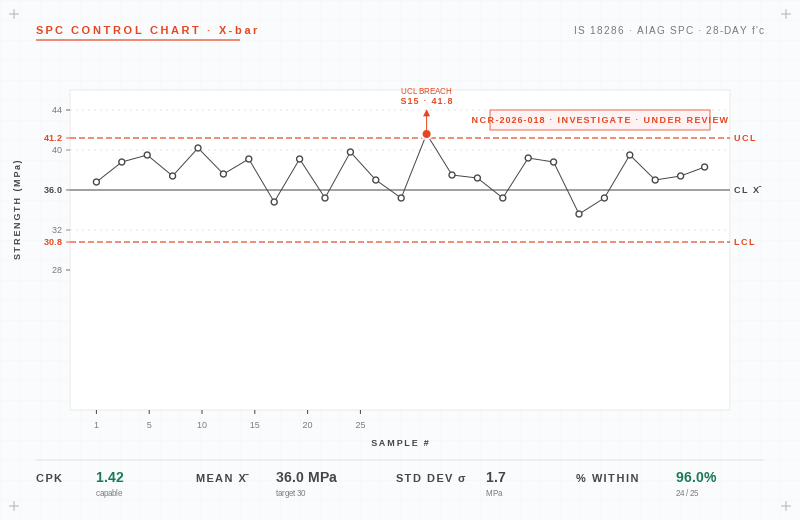
multi-step, role-based approval chainsSPC — X-bar & R, M30 28-day
MPa · liveCatches drift before it becomes a failed cube
Every published failure was preceded by a run. X-bar and R, CUSUM for run detection and EWMA for drift — live per grade, per project location.
- Automatic compliance engine — age-gated acceptance on 7- and 28-day results
- ±15% variation alerts — failure-type classification the moment a result is out of range
- 0.5 MPa rounding — applied exactly as the code prescribes, every time
- NCR → CAPA — one part of the desk; raised from an SPC breach or logged directly, closed with evidence
- Pareto analytics — built automatically from your own defect library as NCRs are logged
- Inspection checklists — hold and witness points inside the checklist itself
Quality control is not a single register
The NCR log is one corner of it. What follows is the rest of what a plant or site laboratory has to keep straight, and what CMDApp keeps on the same record.
Every specimen cast gets a traceable record — cast date, tank assignment, and the field sample it belongs to.
quality · cube castingField samples QR-tagged. Scan the tag and the whole chain opens — field sample to hardened result.
quality · sample registerTank assignment and specimen tracking, so the 7-day and 28-day pulls are never a guess.
quality · curing tankInstrument register with expiry alerts. An overdue CTM, Vicat or slump cone blocks the test it invalidates.
blocks the testScorecards built from delivered batches and their test results — not from a quarterly opinion.
scored from delivered batchesDefects categorised by type and severity at the point of logging, so the Pareto groups them without re-classification.
honeycombing · segregation · slump varianceCompliance scored and graded, not just logged — and it shows which dimension is dragging the score down.
0–100, graded A–DMulti-step, role-based approval on tests, NCRs and CAPAs, so what leaves the plant is signed off.
already shippedComplaints logged against a batch or a pour; target meetings tracked to the action that came out of them.
dashboardsVersion control with approval workflows, so a superseded SOP cannot be printed by mistake.
document controlA competency matrix gating who may perform and sign which test — enforced, not a spreadsheet.
enforced, not a spreadsheetSet your own thresholds for how long a load may sit in the mixer and how long before it must be unloaded — per product, per plant, per distance. Raised while the truck is still moving.
custom thresholds · per product, plant, distance21 dashboards, indexed by lifecycle stage
Role-based galleries — one click per role. 28-day strength predicted from the published relations and validated against actuals, embodied carbon benchmarked to EN 15804 EPDs, and CUSUM/EWMA drift detection ahead of SPC excursions.
Mix strength prediction
7-day in, 28-day outMass concrete thermal
ΔT vs limit · ACI 207Weather & evaporation
ACI 305R / IS 7861Embodied carbon per mix
kg CO₂e/m³Maturity — Nurse-Saul
°C·hours / IS 456 Table 11Pumpability
CIRIA C108 · ACI 304.2RGrouped the way the hub groups them
The Insights hub files its tools under four headings. Here they are in full, with the models and clauses each one runs on.
12 sections: IS 456 gauges, box & violin plots, SPC, histograms, CDF, gain analysis, non-conforming sets, pending tracker.
Plotly · live DB · grade filterMargin above fck and established σ, per project location, per grade.
IS 456 Cl. 16X-bar & R, CUSUM run detection, EWMA drift — against the IS 456 Table 8 standard deviation.
IS 456 Cl. 16 · Table 8Full statistical treatment of strength results, plus Gauge R&R, grading-conformance trend and cement-class verification.
IS 456 Amd.4 · IS 14489 · ASTM C94 · ACI 214RShrinkage and creep over the structure's life, crack width limits, thermal crack risk in a mass pour.
ACI 209.2R-08 · ACI 318-19 · ACI 207.2R-07 · ACI 224R-01Heat of hydration, temperature rise and differential across the pour, with insulation and pour-rate modelling.
ACI 207.1R-05 · 207.2R-07 · 207.4R-05Nurse-Saul and equivalent-age methods, with the stripping recommendation IS 456 gives for that strength.
IS 456 Table 11Your actual cube results over the predicted progression — and the gap explained.
IS 516 · ACI 209Candidate mixes scored side by side on the same axes — strength, workability, cost — campaign after campaign.
MHADA-style formatAndreasen-Andersen, Toufar binary and ternary, De Larrard compaction index, CPM, voids, fineness modulus.
IS 383:2016 · Zone I / II / IIIFresh, hardened and durability properties predicted from proportions before a cube is cast.
Abrams · Powers · fib MC2010 · CEB-FIB · IS 456Pressure loss against pipeline length — is this mix pumpable, and at what stand-off distance?
CIRIA C108 · ACI 304.2R · EN 206Sieve analysis to IS 383 zones, gap-grading and blending, with a single verdict on the supply.
IS 383 · IS 2386Evaporation rate and plastic-shrinkage risk, with hourly site forecast driving the model.
ACI 305R Menzel · IS 7861Hot- and cold-weather corrections to w/c, slump and batch temperature before the pour.
ACI 305 hot weather · ACI 306 coldEmbodied carbon per m³ from EPD factors, mix-to-mix comparison, and the optimisation that brings it down.
EPD master data · EN 15804System defaults plus your own entries — CO₂ kg/t, energy MJ/t, water L/t, transport km — feeding every carbon figure.
system · customPredictive actions
running on your own dataDashboards, indexed by lifecycle stage
22 in allEvery figure traces back to a row
QR verification codes, GPS stamps and touch signatures on every certificate — with the 237-table audit trail behind every figure if a reviewer asks for backup. One click from a dashboard number to the certificate that backs it up.
Output formats
same records, whichever the next person needs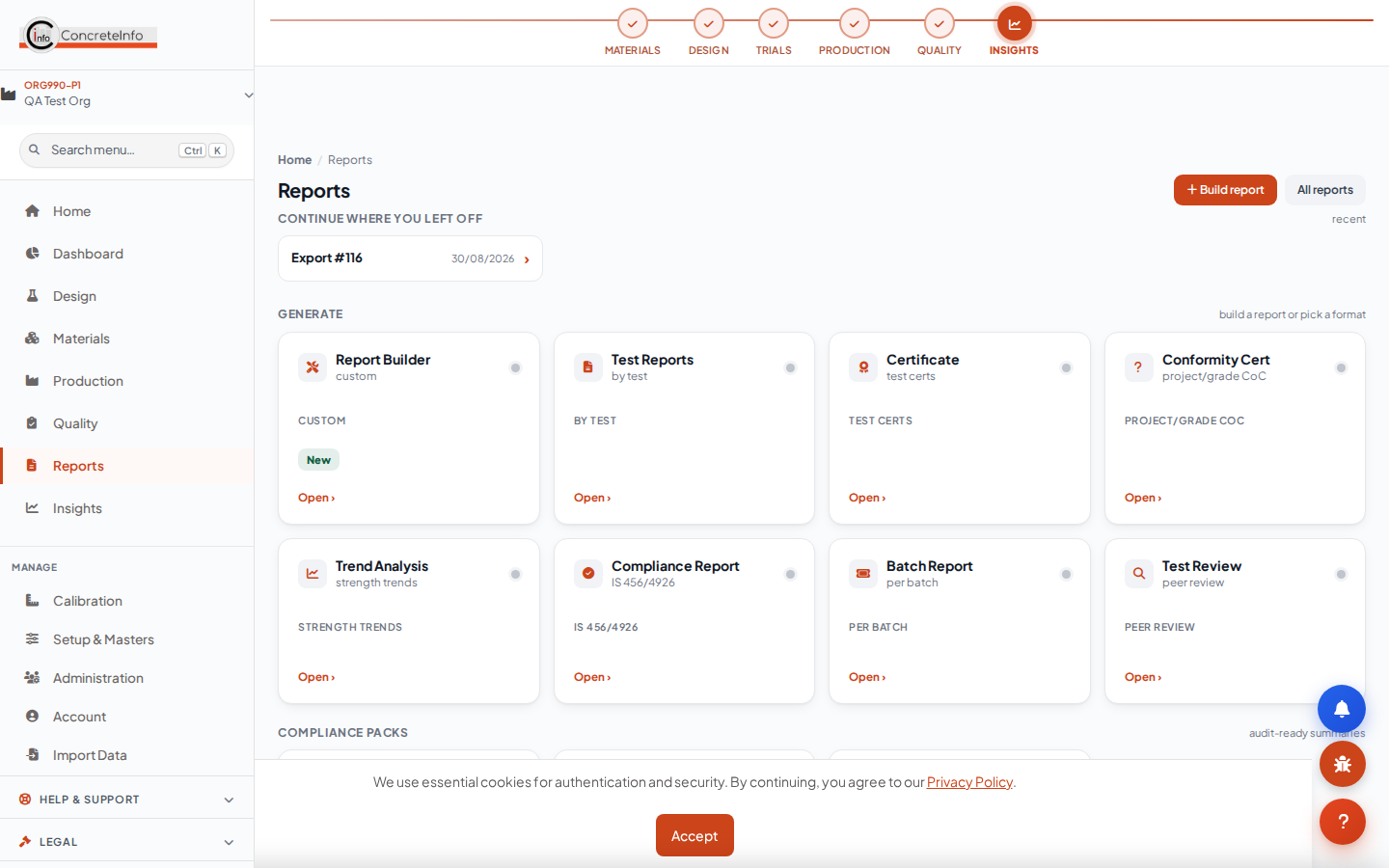
Submittal packages
Mix design report, material datasheets, trial-mix comparison and batch test certificates — each exported straight from the live record, ready for submission.
nothing re-typedApproved before it leaves
Multi-step, role-based approval chains cover tests, NCRs and CAPAs, so what leaves the plant is a signed-off record, not a draft in someone's inbox.
evidence + sign-off on the same recordQR, GPS, signature
Certificates carry QR verification codes, GPS stamps and touch signatures by default — material datasheets and approval blocks included.
verifiable by the recipientStart to certificate, in 1:57
A full walkthrough of CMDApp — mix design, the testing suite, production, quality and insights — run against live data rather than a scripted demo.
It works at the bench with no signal
Log a cube result on the casting yard with no signal; it syncs when the bars come back. Installs to the home screen on iOS and Android. REST endpoints are JWT-authenticated, with webhooks and rate limiting.
Offline-first PWA
Works without a clipboard on the casting yard; caches the forms and syncs the results later.
iOS + Android · installable, no storeTouch-native forms
Touch-friendly forms with context-aware bottom navigation, and card-view data grids built for a phone.
shortcuts straight into New Mix DesignREST API
JWT-authenticated endpoints with webhooks and rate limiting, scoped per plant.
developer pack on request52-table import
Schema-driven CSV and Excel import with column mapping, validation and BOM handling.
injection-protected · scoped per plantOS-level push
Results, NCR triggers, approvals and CAPA deadlines arrive with the browser closed.
RFC 8291 aes128gcm · RFC 8292 VAPIDDedup & merge
Fuzzy duplicate detection across clients, projects and mix designs before they become a problem.
already shippedWhat the platform actually holds
Clause-tagged test methods, each carrying its standard on the form
Analysis tools, each on a published relation rather than a curve of its own
Mix-design methods behind one form, compared side by side
Tables, with a full, exportable audit trail
Five roles, one record
You're choosing plants, not features
Every paid tier includes every module — all six mix-design methods, the full testing suite, NCR/CAPA, SPC, analytics, exports, team management, custom branding and API access. Priced per user.
Free
- 1 default plant
- 3 lifetime designs
- 7-day trial — every module, no restrictions
Solo
- 1 plant
- Unlimited designs & analysis
- Everything in the list below
Growth
- 2–4 plants
- Unlimited designs & analysis
- Everything in the list below
Enterprise
- 5+ plants · unlimited
- Unlimited designs & analysis
- Everything in the list below
This entire category hides its price. None of them are cheap.
Six mix-design standards, the whole testing laboratory, plant and production operations, statistical process control and the analysis engine — every credible platform in this market is sold on a quote, and those quotes are enterprise numbers with implementation projects attached. If you have been through that process you already know. We publish ours instead, per user, per month, cancel any time.
The one published reference point
USD per user / month, billed annuallyReference: a published general analytical LIMS, India pricing, billed annually, minimum 3 users, zero implementation fee — $186 per user/month at 3 users falling to $25 at 100 users. Not a concrete product. Full enterprise RMC QA/QC platforms do not publish at all and are typically quoted in the USD 10k–50k+ per plant, per year range.
| CMDApp | Typical enterprise RMC QA/QC platform | |
|---|---|---|
| Pricing | Public, per user, per month — ₹0 to ₹2,799 | Quote only — typically USD 12k–60k+/plant/yr |
| Getting started | Self-serve, 7-day full trial, no card | Sales call, scoping, implementation project |
| Mix design | Nine methods — IS 10262, ACI 211, BRMCA, EFNARC, HSC, UHPC, mass, CLSM, lightweight | Varies; often add-on |
| Analysis engine | 17 tools — crack prediction (ACI 209/318/207), mass concrete, particle packing, pumpability, maturity | Typically basic statistics only |
| RMC plant operations | Batch OCR, pour card, challans, retention & unload-delay alerts | Usually laboratory scope only |
| Volumes & tests | Unlimited — no per-test charge at any volume | May meter tests, reports or plants |
| Users | Charged per user, no seat cap — every member subscribes to the tier that fits them | Seat-licensed, often with a hard cap |
| Indian standards & NABL | 19 IS codes, NABL-ready 237-table audit trail | Often region-specific |
| Mobile & offline | Offline-first PWA, card views, home-screen install | Varies |
| API & webhooks | Every paid plan, per-module permissions | Enterprise tier only |
| Contract | Cancel monthly, no minimum term | Annual, often multi-year |
Competitor column describes the general shape of the enterprise RMC QA/QC market, not any single named product. No vendor’s price is quoted.
The others, and where to find them
None of them publish a price either, and none of them are cheap. We would rather you compared us on capability and on the number than through a sales call.
Also in this market: Quadrel / Q20, AICreteOS (AICrete), StonemontQC (Stonemont), MetaField — all quote-based. Naming them here rather than leaving a buyer to guess.
Pay once for the year and get 12 months for the price of 10 — 2 months free. Solo ₹12,990, Growth ₹18,990, Enterprise ₹27,990 per user, plus 18% GST. The organization owner invites teammates by email or company domain; each member subscribes to the tier that fits them.
Questions we get asked
Can we put our own logo and colours on the reports?
Yes — custom branding is included on every paid plan. Your logo, colours and organisation name carry through to the PDF, Word and Excel exports, the test certificates and the conformity certificates, so a report leaving your plant does not look like it came from a software vendor. It also applies to the certificate QR verification block.
Is there an API, and can it talk to our ERP?
Yes. Every paid plan includes API access. There is an authenticated REST layer with per-module permissions, webhooks and rate limiting, and material, mix-design, export and billing records are all addressable. Weighbridge terminals and lab instruments post into the same records the team uses in the browser. Route documentation, sample payloads and key management are issued on request rather than published.
What does it cost, and how does annual billing work?
Priced per user, in rupees, plus 18% GST. Pay monthly, or pay once for the year and get 12 months for the price of 10 — that's 2 months free. Annual: Solo ₹12,990, Growth ₹18,990, Enterprise ₹27,990 per user.
What are the plant limits?
Solo includes 1 plant, Growth 2–4, Enterprise 5+ (unlimited). Create plants from My Plants; when you reach your plan's limit you'll be prompted to upgrade. Limits apply to your organization's active plants.
Does every team member pay separately?
Yes — pricing is per user. Your organization's owner (Super Admin) invites teammates by email or from your company domain, and each member subscribes to the tier that fits them and gets their own 7-day trial first.
What is the difference between the paid tiers?
Only the plant count and storage. Every paid tier includes every module — all mix design methods (IS 10262, ACI, BRMCA, EFNARC, HSC, SCC, UHPC, CLSM, LWC), the full testing suite, NCR/CAPA, SPC, analytics, exports, team management, custom branding and API access. You are choosing plants, not features.
What does the free trial include?
Your first login starts a 7-day trial with the full product — every module, unlimited designs, no restrictions and no credit card. After 7 days, unless you subscribe, the account reverts to the Free tier: 1 default plant and 3 lifetime mix designs.
Does it work offline at site?
Yes. It is an offline-first PWA — log a cube result on the casting yard with no signal and it syncs when the bars come back. It installs to the home screen on iOS and Android with no app store involved, and card-view data grids are built for a phone screen.
Where does our data go, and how is it isolated?
CMDApp is a hosted, multi-tenant SaaS — you don't run a server. Each organization is a separate tenant, and every record is scoped to that tenant at the query level: a user only ever sees their own organization’s mixes, tests, plants and certificates, whatever screen they open. The OCR that reads photographed batch tickets and worksheets runs inside ConcreteInfo’s own infrastructure (Tesseract and poppler), so a scanned test report is never passed to a third party. Enterprise customers can ask about a dedicated or on-premise deployment.
Can we import our existing records?
Yes — 52 schema-driven tables are importable from CSV or Excel with column mapping and validation, covering the IS, BS and ASTM record formats. Historic cube results, sieve analyses and certificates can be brought in rather than retyped.
What counts as a "design"?
Each saved concrete mix design counts as one. Editing an existing design does not consume another slot, and paid tiers include unlimited designs.
Can we cancel?
Yes, at any time, from your subscription page. You retain access until the end of your current billing period.
Are payments secure?
All payments are processed by Razorpay, a PCI-DSS compliant gateway. Card details are never stored on our side.
Built against the codes you already work to
Seven days. Every module. No card.
Seven-day trial: every module, unlimited designs, no restrictions and no card on file. Sign in with Google, LinkedIn or Microsoft — no password to set. Reverts to Free (3 lifetime designs) if you don't subscribe.